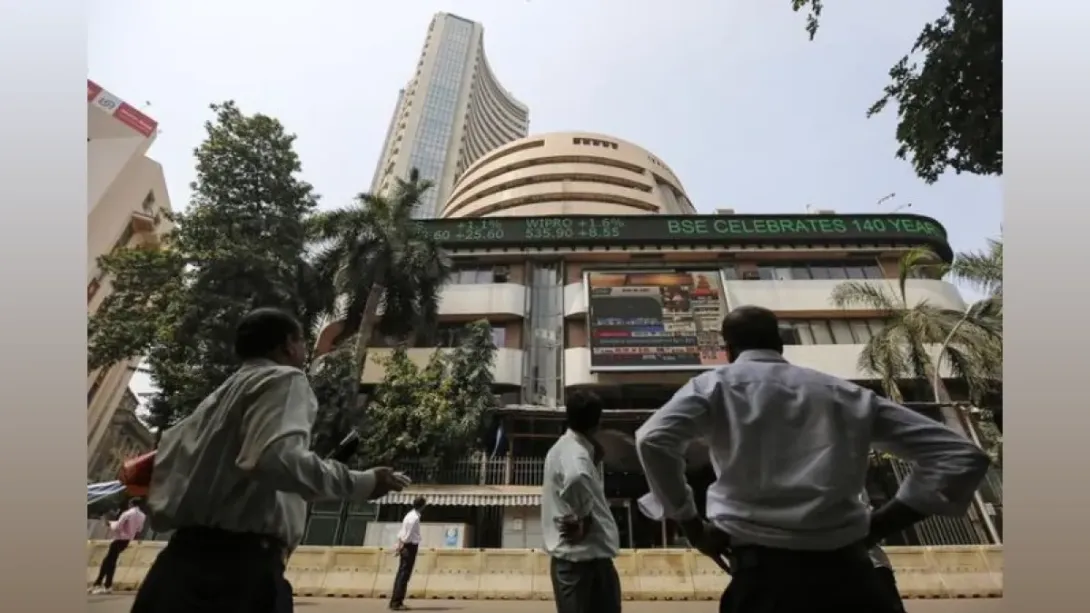
India’s equity markets witnessed a sharp erosion in corporate valuations last week as global geopolitical tensions and rising crude oil prices dampened investor sentiment. The combined market capitalisation of eight of the country’s ten most valuable companies declined by Rs. 2,81,581.53 crore during the period, reflecting the broader weakness in equities. Banking giants and infrastructure firms were among the biggest casualties, with State Bank of India recording the steepest decline. The benchmark BSE index also fell significantly, highlighting heightened volatility in the financial markets. Despite the broader downturn, Reliance Industries and Infosys emerged as rare gainers, offering limited support to an otherwise bearish market environment.
Equity Market Turbulence Weighs on Corporate Valuations
India’s leading corporations experienced a significant decline in market capitalisation last week as equity markets struggled under the pressure of global economic uncertainties. The combined valuation of eight of the country’s ten most valuable listed companies shrank by Rs. 2,81,581.53 crore, underscoring the intensity of the market downturn.
The sharp fall coincided with a broader decline in domestic equities, with the benchmark BSE index dropping 2,368.29 points, or approximately 2.91 percent, during the week. The correction reflects growing investor caution amid escalating geopolitical tensions and volatile commodity prices.
Market participants adopted a defensive stance as global developments triggered concerns about inflationary pressures and economic stability.
Banking and Financial Stocks Lead the Decline
Financial sector heavyweights were among the hardest hit during the market downturn. The State Bank of India recorded the steepest decline in valuation, with its market capitalisation falling by Rs. 53,952.96 crore to Rs. 10,55,567.27 crore.
Private-sector banking giants also experienced substantial losses. The market value of ICICI Bank dropped by Rs. 46,936.82 crore, bringing its valuation down to Rs. 9,40,049.82 crore. Similarly, HDFC Bank witnessed a decline of Rs. 46,552.3 crore, reducing its market capitalisation to Rs. 13,19,107.08 crore.
These declines highlight the sensitivity of financial stocks to broader market sentiment and macroeconomic uncertainty.
Infrastructure and Technology Firms Also Under Pressure
Beyond the banking sector, several large-cap companies across infrastructure, financial services, and technology also saw their valuations contract.
Engineering and construction conglomerate Larsen & Toubro experienced a reduction of Rs. 45,629.03 crore in its market capitalisation, bringing its total valuation to Rs. 5,43,208.36 crore.
Bajaj Finance, a leading non-banking financial company, saw its valuation fall by Rs. 28,934.56 crore to Rs. 5,91,136.03 crore. Meanwhile, technology giant Tata Consultancy Services registered a decline of Rs. 28,492.44 crore, lowering its market capitalisation to Rs. 9,25,380.15 crore.
Consumer goods major Hindustan Unilever also faced selling pressure, with its valuation dropping by Rs. 26,350.67 crore to Rs. 5,23,042.51 crore. Telecommunications leader Bharti Airtel recorded a relatively smaller decline of Rs. 4,732.75 crore, bringing its market value to Rs. 10,67,120.50 crore.
Reliance Industries and Infosys Defy the Downtrend
Despite the widespread market weakness, two companies from the top-10 list managed to record gains during the week.
Reliance Industries strengthened its position as India’s most valuable listed company, adding Rs. 14,750.39 crore to its market capitalisation. The company’s total valuation rose to Rs. 19,01,583.05 crore, reinforcing its dominance in the domestic corporate landscape.
Technology services firm Infosys also bucked the negative trend, with its market capitalisation increasing by Rs. 3,459.99 crore to reach Rs. 5,30,546.54 crore.
The gains in these companies provided limited stability in an otherwise volatile market environment.
Global Factors Driving Market Sentiment
Market analysts attribute the sharp correction in equities primarily to external geopolitical developments and commodity price movements. Escalating tensions in West Asia have increased uncertainty across global financial markets, prompting investors to adopt a cautious approach.
At the same time, a sharp increase in crude oil prices has raised concerns about inflationary pressures and potential impacts on economic growth. Rising energy costs often influence corporate earnings expectations and can dampen market sentiment.
These global developments have led to heightened volatility in equity markets worldwide, with India’s markets reflecting similar trends.
Ranking of India’s Most Valuable Companies
Despite the fluctuations in valuations, the hierarchy of India’s most valuable companies remained largely unchanged.
Reliance Industries continues to hold the top position, followed by HDFC Bank and Bharti Airtel. Other companies in the top tier include State Bank of India, ICICI Bank, Tata Consultancy Services, Bajaj Finance, Larsen & Toubro, Infosys, and Hindustan Unilever.
These firms collectively represent a significant share of India’s total market capitalisation and play a crucial role in shaping investor confidence in the domestic equity market.
Outlook for Investors
The recent market correction highlights the vulnerability of equity markets to global geopolitical and economic developments. Investors are expected to remain cautious in the near term as they monitor international tensions, commodity price movements, and macroeconomic indicators.
While short-term volatility may persist, analysts suggest that long-term investors often view such corrections as opportunities to accumulate fundamentally strong stocks at more attractive valuations.
For now, however, the market remains sensitive to global cues, with investor sentiment closely tied to developments beyond domestic economic fundamentals.
Comments